📅 Publish date: 23/10/2026
Building a B2B Growth Engine Journey by Journey
“Last quarter was great. This quarter is empty.”
I’ve heard a version of that in almost every growth programme I’ve walked into, usually from a team that did nothing wrong. They ran a good campaign. It produced leads. It ended. And when it ended, the only mechanism putting people into the pipeline ended with it.
Then comes the budget conversation, and it always has the same shape: more of that, but bigger.
A campaign buys attention for as long as you keep paying. An engine keeps running after the invoice. There’s a simple test for which one you have: name one thing you built last quarter that is still producing pipeline this quarter without anyone relaunching it. If the answer is nothing, you don’t have an engine yet. You have a series of campaigns with a reporting layer on top.
This post is about how an engine actually gets built, which is one journey at a time, each one validated before it gets switched on permanently.
A growth engine is a set of journeys, not a bigger campaign
The term has been stretched to mean almost anything, so here’s how I use it with teams.
A growth engine is a connected set of customer journeys that keep producing qualified pipeline without being relaunched. Each journey has an entry point, a reason to take the next step, a follow-up that moves someone forward, and a moment where sales picks them up. And each one was tested before it was switched to always-on.
Three things it isn’t.
- Not a campaign. A campaign has an end date and a spike in the graph after it. An engine has an owner and a monthly number.
- Not a tool stack. Marketing automation, lead scoring and a CRM are where an engine runs, not what it is. Buying the machinery is not the same as building the production line.
- Not a funnel diagram. The diagram describes your theory of how people buy. The engine is the set of journeys that actually run today, with triggers, content and an owner behind every step.
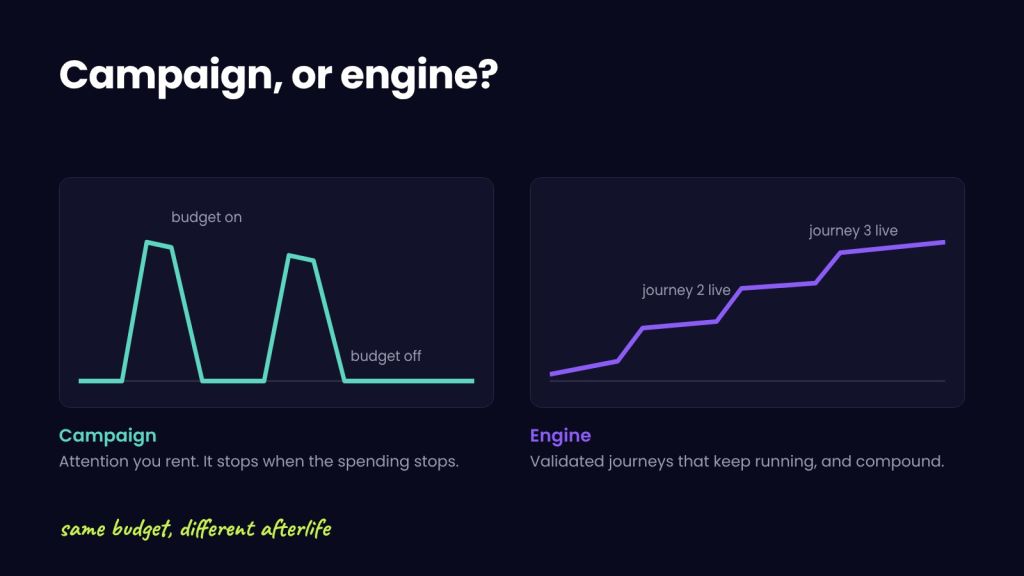
The distinction decides what you’re buying with next quarter’s budget: reach you rent, or an asset that keeps working. A campaign produces a spike that falls back to zero when the budget stops, while an engine produces a lower line that keeps running and compoundsThe question isn’t which line is higher this month. It’s which one is still there next quarter.
Why the funnel picture keeps failing you
Most engines get designed as one journey: awareness, consideration, decision, one path, one speed. Real B2B buyers don’t behave like that.
They touch you at different points in the funnel, in no particular order, often months apart. Someone reads an article and forgets you. A colleague shares something six months later. They come back through a comparison page, download one thing, and book a call in the same week. A single linear journey can’t catch that, because it has one entry point and assumes everyone arrives at the same stage.
So you build several journeys next to each other. Each one sits on a theme your buyers actually care about, and each has its own entry points: an organic post, a paid ad, a landing page, an event, a downloadable, a piece of outbound. What makes them an engine rather than a pile of campaigns is that they share content and share one CRM. Someone who reads two pieces in theme A and downloads one in theme B is a single record with a score that reflects both.
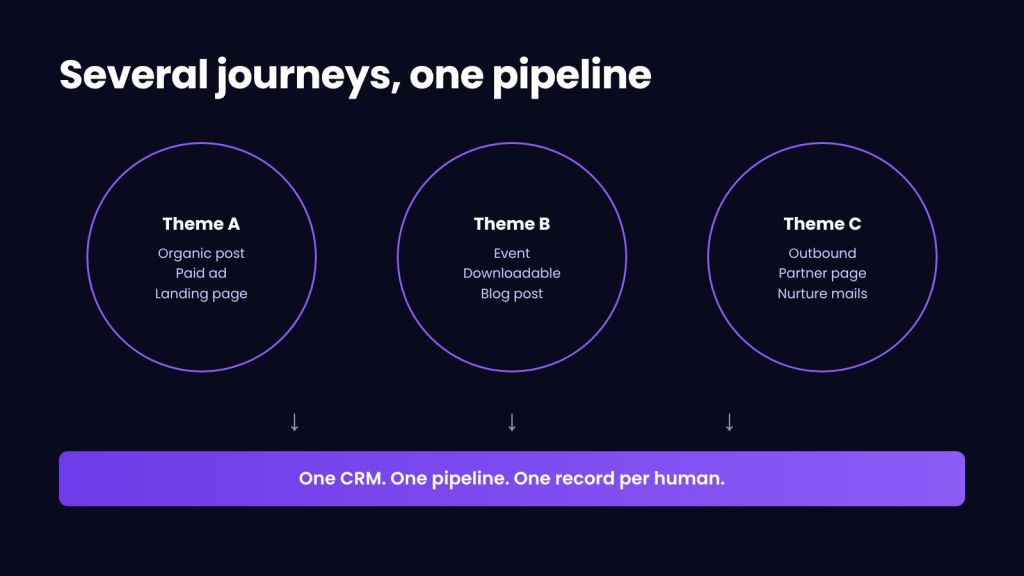
Practical consequence: stop asking “what’s our funnel?” and start asking “which journeys are running right now, and which one can a stranger enter today?” Most teams find they have exactly one, and it starts with a demo request. Which means they only catch the buyers who had already made up their mind.
Build the first journey where demand already exists
You can’t build six journeys at once with a team of three, so the first real question is which one to build first. The answer is almost never the most interesting one.
Start where demand already exists and something is leaking. Three places to look:
- Pages that already get qualified traffic and offer nothing but “contact us”. The visitors are there, the interest is there, and the only available next step is the biggest one you have.
- A sales motion that works but doesn’t scale. Your best seller’s personal outreach is already a validated journey. It just runs on one person’s calendar. The engine version is the same sequence with data, content and follow-up behind it.
- The question sales answers in every single call. If it comes up every time, it’s not an objection, it’s an entry point. Answer it publicly, properly, once.
The common mistake is to start at the top, with awareness, because that’s the part that feels like marketing. Awareness is the most expensive thing to validate, the slowest to read, and worth nothing if the next three steps don’t exist yet. Build the back half of the journey first, then point traffic at it.
Validate the handovers, not the assets
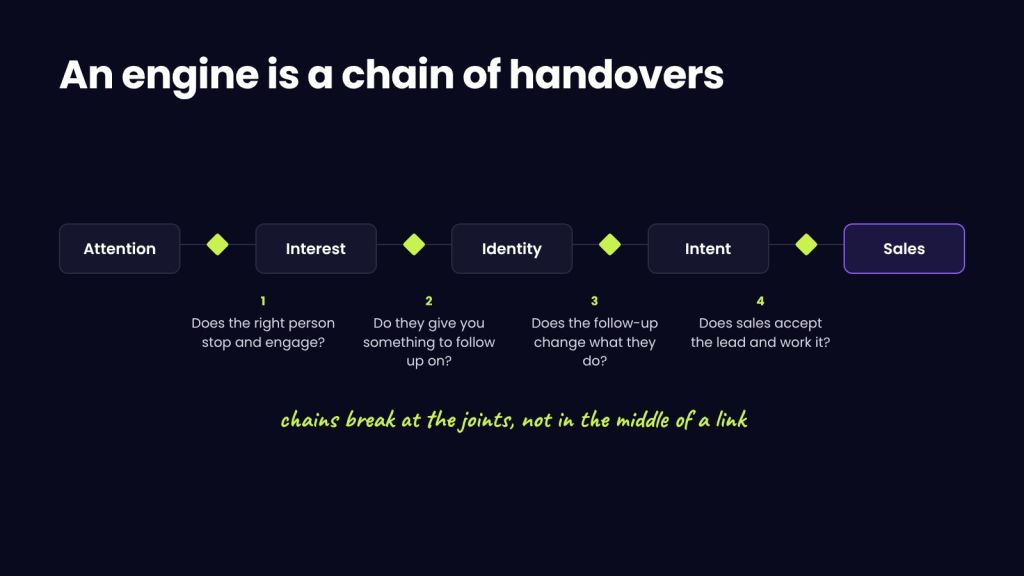
An engine is a chain of handovers, and chains break at the joints.
Every journey has four:
- Attention to interest. Does the right person stop, and do they engage with the thing you put in front of them?
- Interest to identity. Do they give you something you can follow up on, and is the trade honest enough that they don’t regret it?
- Identity to intent. Does your follow-up change what they do, or does it just arrive?
- Intent to sales. Does sales accept the lead, work it, and recognise it as the kind of conversation they want?
Most teams test the assets instead: the headline, the image, the form, the subject line. Those tests tell you whether the asset was any good. They don’t tell you whether the handover works. You can win every asset test in a journey and still have a chain that quietly drops everyone between the third joint and the fourth.
So for each handover, write down what “it works” means as a number, before anything launches. What share of the people who land here take the next step. What share of the leads sales accepts. Those numbers are what decide whether the journey earns a permanent slot, and agreeing them upfront is the difference between a result and an argument. (I wrote about setting those decision rules in more detail in the CRO playbook.)
The fourth handover is the one that gets skipped, and it’s the one that kills most engines. If nobody can tell you what share of handed-over leads sales actually works, that’s your first measurement, not your first campaign.
You build one validated journey, then the next one on top of it. This creates your growth engine.
Switching to always-on is a decision, not a deadline
A validated journey earns the right to keep running. Someone should make that call explicitly, against the criteria you wrote down, on a date. It’s a promotion, not the end of a project.
Four things change at that moment:
- Budget moves from a test amount that can be stopped to a line that renews.
- Ownership moves from whoever ran the test to whoever reports the journey’s numbers every month.
- Maintenance gets a cadence. Journeys decay: the content ages, the audience saturates, the offer stops being new.
- Measurement changes question. Not “did the test win” but “is this still converting at the level we signed off on”.
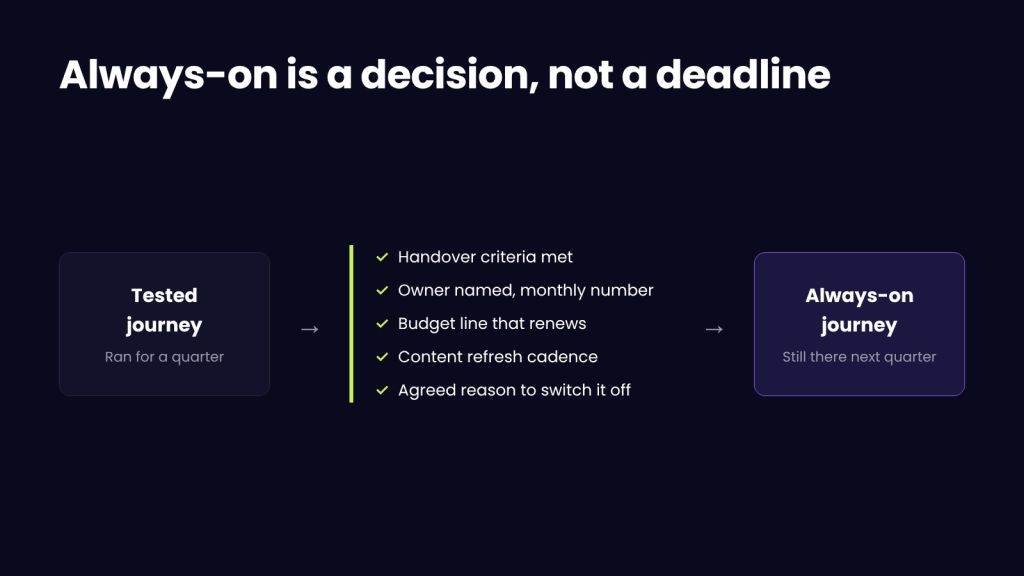
And one rule that saves you two years from now: write down what would make you turn it off again. Engines silently accumulate journeys that used to work, because switching something off is nobody’s job unless it was somebody’s decision.
The budget shape changes, and so does the conversation with finance
A classic marketing budget is one large commitment, decided mostly upfront: a production, a media plan, a campaign. You find out whether it worked when it’s over.
A growth budget is a series of small commitments that grow as the evidence does. The first test is deliberately cheap. The second is bigger, because the first one told you something. By the time real money is going in, it’s going into something you’ve already watched convert.
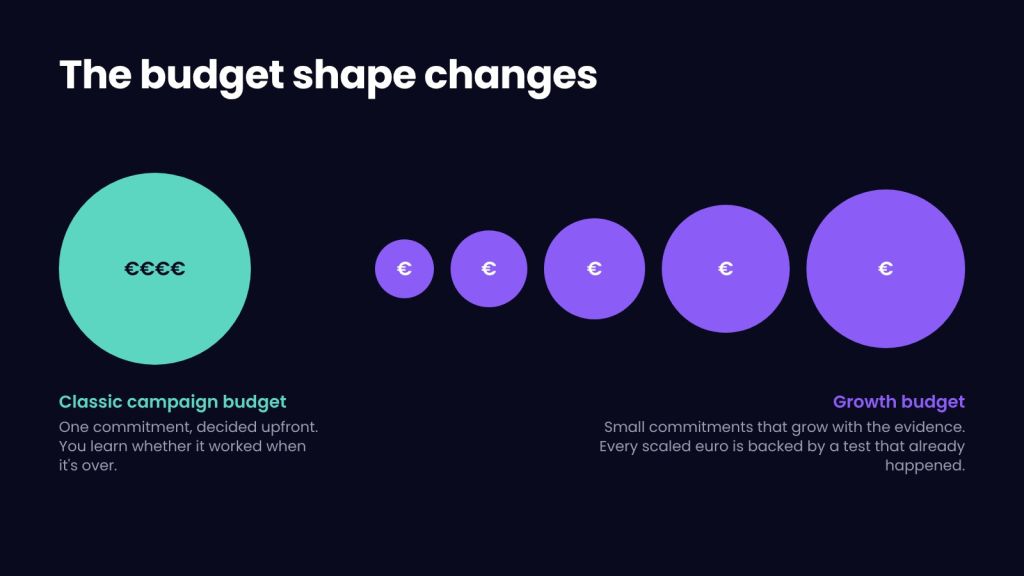
That’s a different conversation with your CFO, and a much easier one. You’re not asking for a campaign budget against a promise. You’re asking for a small amount to find something out, with an agreement on what gets scaled and what gets stopped. Every euro in the always-on engine is backed by a test that already happened.
It changes the cost per qualified lead over time too. A campaign starts from zero every time it launches. A journey that’s been running for four quarters has content that ranks, an audience that’s seen you before, and a nurture flow that’s been rewritten twice on real data. Same budget, better conversion, because the thing has history.
One pillar, many loops
What makes several journeys possible with a small team isn’t more content. It’s content that gets used more than once.
Do the strategic thinking once per theme: who you’re talking to, what they’re trying to decide, and what you know that they don’t. Then make one substantial thing, the kind that takes real time. A piece of research, a playbook, a webinar, a teardown of how something actually works. That’s your pillar.
Everything else is a variant of it. The blog post, the organic posts, the ad, the landing page, the downloadable, the nurture emails, the one-pager sales sends after a call. Same insight, different format, different place in the journey.
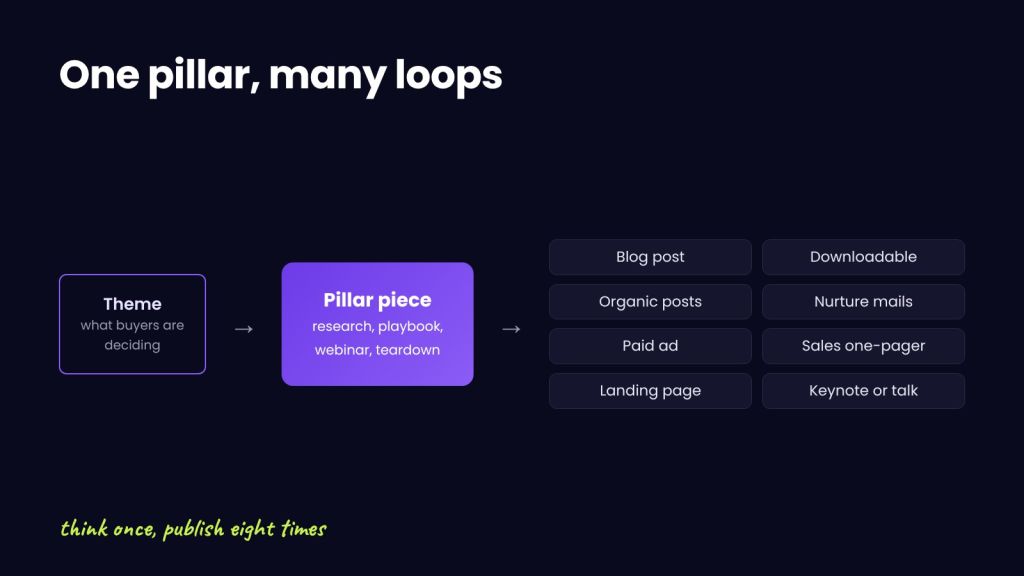
One pillar per quarter, done properly, feeds more journey steps than six blog posts written separately. It also compounds, because every variant points back at the same asset. That’s how you end up being the clearest source on your own topic, which matters more now that AI gets to the answer before the click.
Four places engines break
In the programmes I’ve worked on, the failure is hardly ever in the campaign layer. It’s in one of these four.
- The sales handover. Marketing counts leads, sales counts deals, and nobody counts what happens in between. Agree on what a lead has to look like before it’s handed over, and measure how many get worked. This is a definition problem before it’s a quality problem.
- Nurture that’s really a newsletter. A nurture journey has a job: move someone from interested to ready. A newsletter has a schedule. If your flow would still make sense sent to everyone in a random order, it isn’t a nurture journey.
- No feedback loop on lead quality. If sales’ judgement never travels back to targeting, your engine optimises for volume, because volume is the only signal it gets. One recurring call where sales rates what came in is enough to start. Without it, the machine gets confidently worse.
- Tracking built for a campaign. Journeys run for quarters and cross devices, sessions and months. Measurement set up for a six-week burst will tell you the last click mattered and nothing else did. You don’t need perfect attribution, you need to be able to see a journey end to end.
What I'd do in the first 90 days
- Map what’s actually running. Not the funnel on the slide. The journeys a stranger could enter today, with their entry points and their owners. Expect the list to be shorter than everyone assumes.
- Pick one journey where demand already exists and something is leaking.
- Write the four handover criteria before you build anything, and get sales to sign off on the fourth one.
- Build the back half first. Capture and follow-up, then point traffic at it. Paid traffic is the easiest part to add and the most expensive thing to waste.
- Run it for a couple weeks to get data, then decide. Always-on, iterate, or stop. Write the decision down, then start the next journey.
The engine is the part that survives
A campaign is a loan. You get attention now and you pay it back the moment you stop spending. A journey you validated and switched on is an asset: it’s still there next quarter, it gets cheaper per lead, and it makes the next journey easier to build because the content, the data and the handover already exist.
Nobody builds the whole thing in one go, and the teams that try usually end up with six half-finished journeys and no evidence. Build one. Validate the joints. Switch it on. Then build the next one on top of what you learned.
If this way of working is new to your organisation, the harder part is rarely the mechanics. It’s getting people comfortable with deciding on evidence, which I wrote about in adopting growth experimentation in marketing culture.
Quick answers
What is a growth engine?
A growth engine is a connected set of customer journeys that keep producing qualified pipeline without being relaunched. Every journey has an entry point, a next step, a follow-up and a handover to sales, and each one is tested before it runs permanently. The difference with a campaign is simple: a campaign stops when the budget stops, an engine keeps running.How many journeys do I need?
Start with one and validate it end to end. Most B2B teams get real leverage from three or four journeys running side by side, each tied to a theme their buyers care about. Six half-built journeys produce less pipeline than one that works.Do I need marketing automation to build one?
Not to start. You need one place where leads land, a way to see what they did before they got there, and someone who follows up. Automation makes an engine scale, it doesn’t make it work. Teams that buy the platform first usually end up with an expensive newsletter.How long before a growth engine produces pipeline?
Expect a quarter to validate the first journey and a second quarter before it’s running reliably enough to count on. If your sales cycle is long, the early signal comes from the handovers, not from closed deals: are the right people entering, and does sales want the conversations they’re getting?Support
If you liked the article sharing it with your peers is really appreciated. Thank You!