📅 Publish date: 09/10/2026
SEO vs GEO: 7 Lessons for Marketing Teams When AI Answers First
SEO is dead? Again?
It gets declared dead every few years. Mobile was going to kill it. Voice search was going to kill it. Now AI is going to kill it, and this time the obituary comes with a chatbot that writes it for you.
I’m not an SEO specialist. I’m a growth lead who works side by side with SEO specialists, and this year the same question landed on almost every marketing leader’s desk I know: “Do we now need a GEO strategy next to our SEO strategy?”
Short answer: no. Longer answer: the rules barely changed. The scoreboard did. Below are the seven learnings that stuck with me, the numbers behind them, and what I’d do about it this quarter.
7 learnings in 30 seconds
- Two front doors, one house. AI search lives inside Google and outside it. The same foundation serves both.
- The scoreboard moved from clicks to citations. Being in the answer is the new page one.
- AI doesn’t search your keyword. It fans out into a dozen related questions.
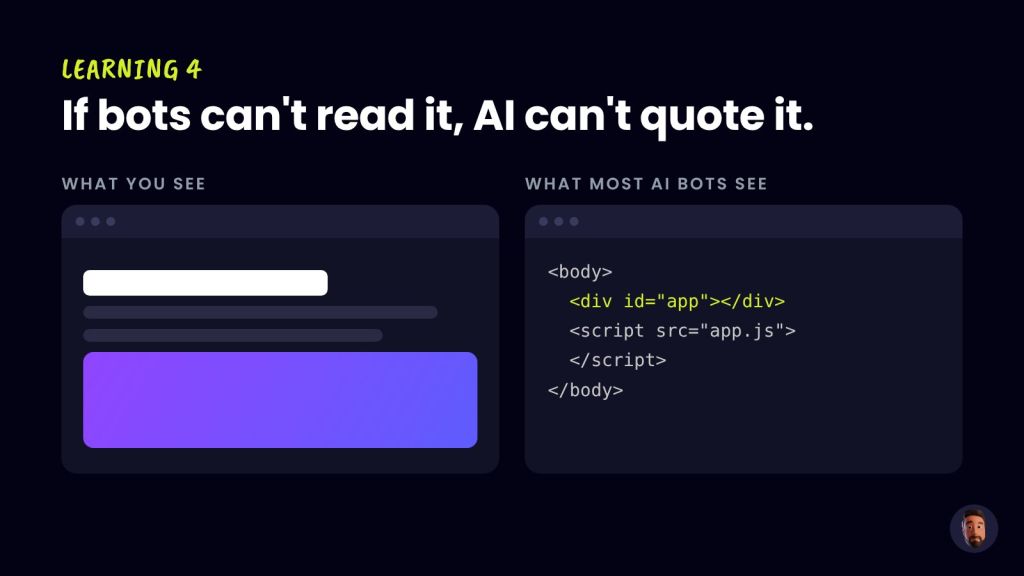
- If bots can’t read your page, AI can’t quote it. Most AI crawlers don’t run JavaScript.
- There are no GEO hacks. Google said so itself. Good habits win.
- Be the clearest source on your own topic. Or Reddit will be.
- Measure it like a growth experiment. Baseline, test, learn. Not a ranking report.
First: what actually changed in search?
Google’s AI Overviews arrived in Belgium in March 2025. AI Mode followed in October 2025. ChatGPT, Gemini, Copilot and Perplexity now answer questions people used to type into a search bar. A few numbers show what that does to behaviour:
- In a Pew Research Center study of 68,879 real Google searches, people clicked a regular result on 8% of visits when an AI summary appeared, versus 15% without one. The links inside the summary itself? Clicked on 1% of visits.
- SparkToro and Similarweb found that 68% of US Google searches ended without a click in the first four months of 2026, up from 58.5% in 2024.
- In Europe, ChatGPT holds roughly 79% of AI chatbot usage, with Gemini around 13% (Statcounter, September 2026).
- But 95% of ChatGPT users still visited Google, while only 14% of Google users visited ChatGPT (Similarweb, August 2025).
That last one matters. People don’t switch, they stack. They ask ChatGPT, double-check on Google, and skim an AI Overview on the way. How often AI Overviews show up depends on who’s counting (estimates range from about a fifth to over 40% of searches), but the direction is the same everywhere: more answers, fewer clicks.
Here’s the uncomfortable part for anyone reporting on sessions: you can be quoted as the answer and still see your traffic go down. If your dashboard only counts visits, it’ll tell you you’re losing while you might be winning.
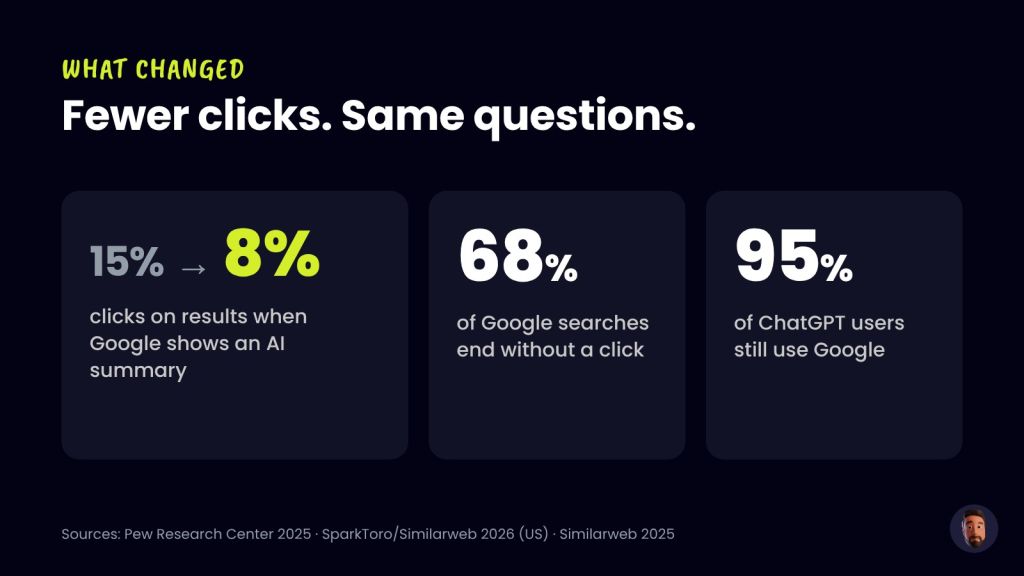
Clicks drop from 15% to 8% when Google shows an AI summary, 68% of searches end without a click, and 95% of ChatGPT users still use Google
Sources: Pew Research Center (2025), SparkToro/Similarweb (2026), Similarweb (2025).
1. Two front doors to AI search, one house behind them
AI search shows up in two places, and it helps to keep them apart.
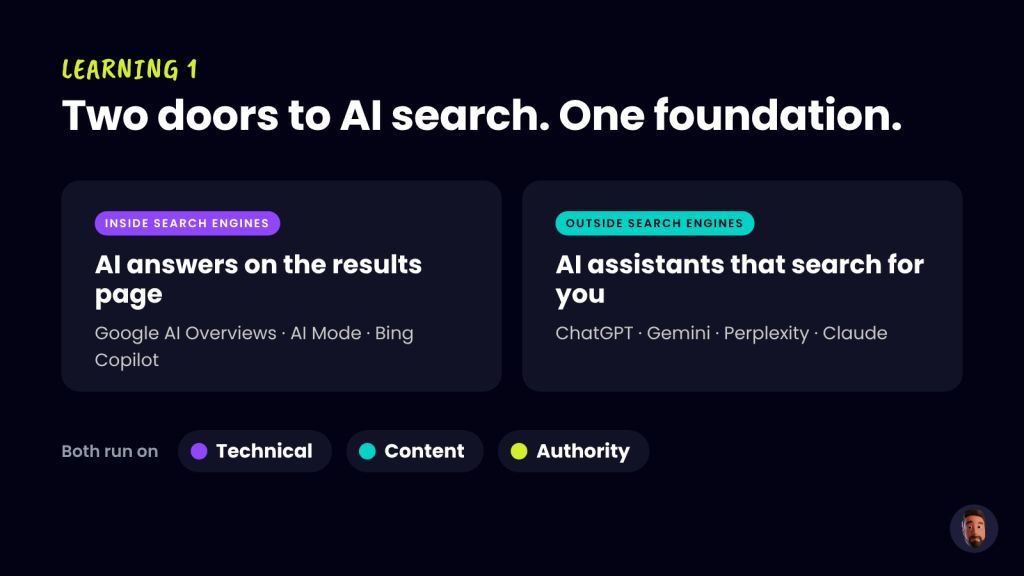
Inside search engines: Google’s AI Overviews and AI Mode, and the Copilot answers in Bing. These sit on top of the classic search index, so your rankings still matter a lot here. Ranking well is often your ticket into the summary.
Outside search engines: ChatGPT, Gemini, Copilot, Claude, Perplexity, Mistral. For specific or recent questions they search the web live, pick a handful of sources and write one answer, sometimes with citations.
Different doors, same house. Both reward a website that machines can access, that clearly answers real questions, and that other people trust. Technical, content, authority: the three pillars of SEO since forever.
Good news if you’ve invested in a solid SEO foundation: you’re not starting from zero. Bad news if you haven’t: no GEO tactic will paper over it.
2. The scoreboard moved from clicks to citations
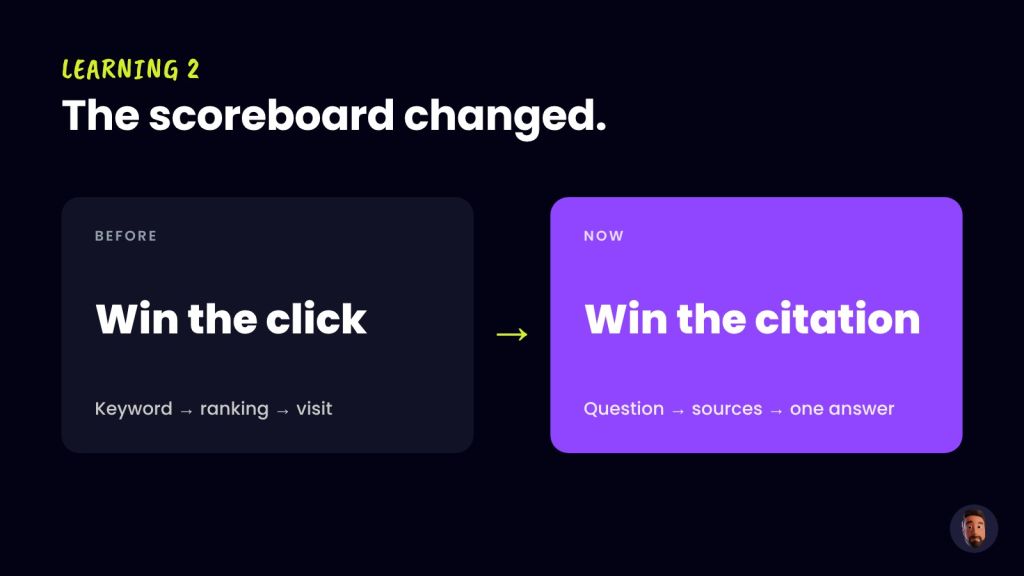
Classic search was a simple chain: someone types a keyword, you rank on page one, they click, you win the visit. AI search adds a step in the middle. Someone asks a full question, the AI picks a few sources, writes one answer, and maybe cites you. The win is no longer the visit. The win is being in the answer: mentioned, cited, recommended.
Some call this GEO (generative engine optimisation), some AEO (answer engine optimisation), some “search everywhere optimisation”. I care less about the acronym and more about what it does to your KPIs.
Practical consequence: stop judging content by sessions alone. Track whether your brand shows up in answers for the questions that matter to your buyers, and whether the traffic that does arrive converts. Visitors who do click through from an AI answer have often done part of their homework already, so judge them on quality, not just volume.
3. AI doesn't search for your keyword. It searches a dozen questions around it.
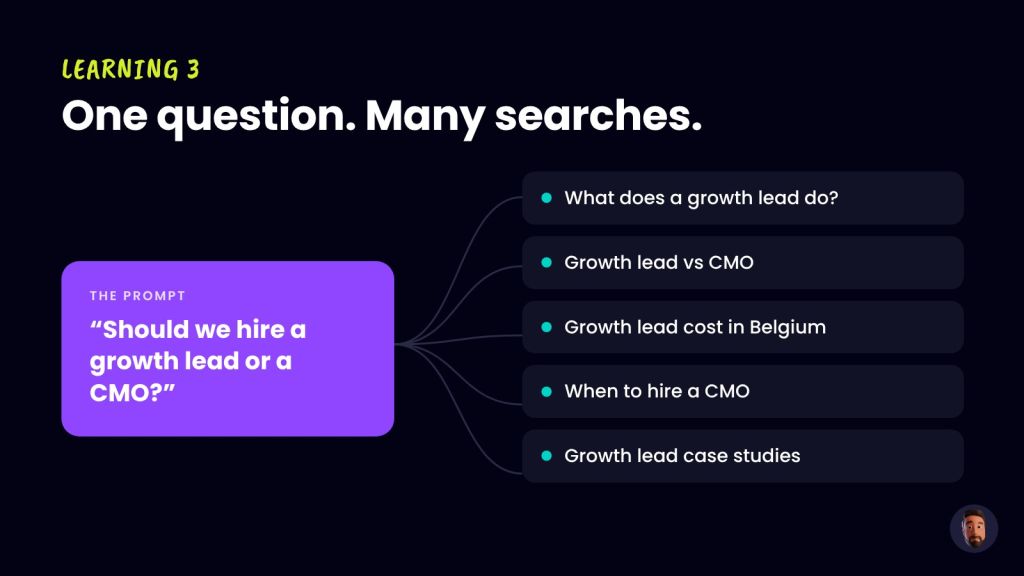
When you ask Google’s AI Mode or ChatGPT a complex question, it doesn’t run one search. It breaks your prompt into sub-questions, searches each of them, and stitches the results into one answer. This is called query fan-out.
Take a question my own buyers might ask: “Should we hire a growth lead or a CMO?” Behind the scenes, that can fan out into definitions, comparisons, local pricing, timing and proof.
Two things follow from this.
First, not every question is up for grabs. Ask “what is marketing?” and the model answers from what it already knows. Specific, recent, local or comparative questions are the ones that trigger a live web search. That’s where you can compete.
Second, keyword research becomes question research. The best sources are still the boring ones: your sales and support teams, the queries in Google Search Console, the “People also ask” boxes, tools like AlsoAsked, and the questions people ask you after a talk. The most underrated keyword tool in your company is still your sales team.
4. If bots can't read your page, AI can't quote it
This is the most technical learning, and the one with the fastest payoff.
Most AI crawlers don’t execute JavaScript. Vercel analysed crawler traffic across its network and found that OpenAI’s, Anthropic’s and Perplexity’s bots fetch your HTML but don’t render JavaScript. Google’s crawler (which also feeds Gemini) and Applebot do. So if your key content loads client-side (pricing tables, product specs, FAQs in a fancy widget), ChatGPT may be looking at an empty page.
A test anyone on your team can do in ten seconds: open an important page, right-click, choose View page source, and search for a sentence from your main content. Not there? Then a large part of AI search can’t read it either. The fix is server-side rendering, or serving the content that matters as plain HTML.
Second check: your robots.txt. Blocking AI bots is a legitimate choice, but make it on purpose. OpenAI, for example, uses separate bots for training models (GPTBot) and for ChatGPT search (OAI-SearchBot). Blocking the first doesn’t remove you from ChatGPT’s answers. Blocking the second does.
The rest is classic technical hygiene: a logical site structure, strong internal linking, fast pages, and structured data where it helps.
5. There are no GEO hacks. Google said so itself.
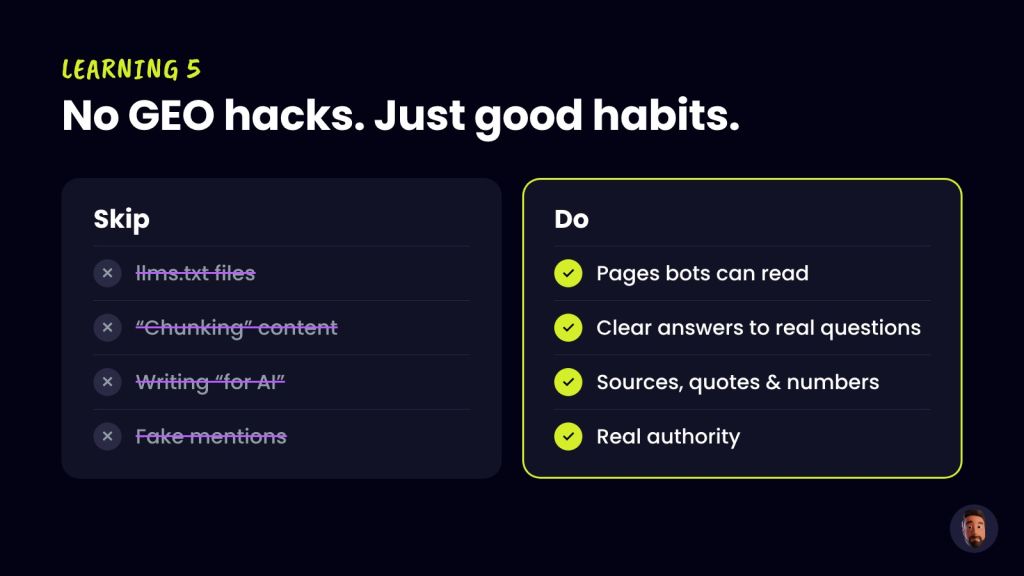
In May 2026, Google published guidance on optimising for generative AI search, including a list of things you can safely ignore:
- creating an
llms.txtfile or other special “AI files” - “chunking” your content into bite-size pieces for AI
- rewriting content specifically for AI systems
- chasing inauthentic mentions across the web
- adding special schema markup for AI (structured data is still useful for rich results, just not a magic AI switch)
Their message, in short: optimising for generative AI search is optimising for search.
Healthy scepticism applies. That’s Google talking about Google, and other engines can behave differently. But independent research points the same way. A 2024 study on generative engine optimisation by researchers from Princeton and IIT Delhi found that adding citations, quotations and statistics boosted a source’s visibility in AI answers by up to 40%.
Read that list again: cite your sources, quote experts, add numbers. That’s not a hack. That’s good writing with evidence.
“Can you just make ChatGPT say nice things about us?” is the 2026 version of “Can you make this page SEO-proof, but without changing anything?” Same wish, new acronym. The answer hasn’t changed either.
6. Be the clearest source on your own topic, or someone else will be
AI trusts the clearest source it can find, even when that source is a joke. In May 2024, Google’s AI Overviews advised adding non-toxic glue to pizza sauce (source: an old Reddit joke) and eating a small rock a day (source: satire site The Onion). Earlier that year, a Canadian tribunal held Air Canada responsible for a refund policy its own chatbot had invented. The airline argued the chatbot was responsible for its own actions. The tribunal didn’t buy it.
The lesson for brands: if you don’t publish the clear, current answer about your products, pricing, policies and expertise, AI will fill the gap with whatever it finds. A forum thread. An outdated review. A competitor’s comparison page. When a team asks “why is another website quoted about us?”, the answer is usually uncomfortable: that website explained it better.
What helps:
- Answer the real questions in plain language, on pages built for them: FAQs, how-tos, comparisons, pricing logic.
- Publish what only you know. Google stresses content that adds something beyond what’s already everywhere: your data, your cases, your point of view. Commodity content gets summarised. Original content gets cited.
- Show who’s talking. Real experts as authors, with bios. Transparent company information. Sources. This is the E-E-A-T idea (experience, expertise, authoritativeness, trust) in practice.
- Earn authority off your site. Digital PR, reviews, partner pages, podcasts, talks. A few strong, relevant mentions beat hundreds of weak ones.
- Keep it fresh. Outdated pages produce outdated answers.
If you don’t tell AI who you are, someone else will.
7. Measure it like a growth experiment
GEO measurement is young and imperfect, which is exactly why a growth mindset fits. You won’t get a perfect dashboard. You can get a baseline and a direction. What you can measure today:
- AI referral traffic in GA4. Create a custom channel group for sources like chatgpt.com, perplexity.ai, gemini.google.com, copilot.microsoft.com and claude.ai. Volumes are small, intent is often high. (New to GA4 setups? Here’s what changed for marketing teams.)
- Citations in Bing. Since February 2026, Bing Webmaster Tools has an AI Performance report showing how often Copilot and Bing’s AI answers cite your pages, plus the queries behind those citations. Google Search Console doesn’t split this out (yet).
- Prompt tracking. Tools like Peec AI, Otterly, Rankshift or Promptwatch run a fixed set of prompts and check whether you’re mentioned. A spreadsheet with 20 prompts, checked monthly, is a fine start.
- Business signals. Branded search volume, direct traffic, lead quality, and a simple “How did you hear about us?” field in your forms.
Then treat it like any experiment: hypothesis, change, measure, keep or kill. One caveat: AI answers vary by user, phrasing and day. Look at trends across many prompts, not one screenshot someone forwarded on Slack. (More on building that habit in adopting growth experimentation in marketing culture.)
What I'd do this quarter
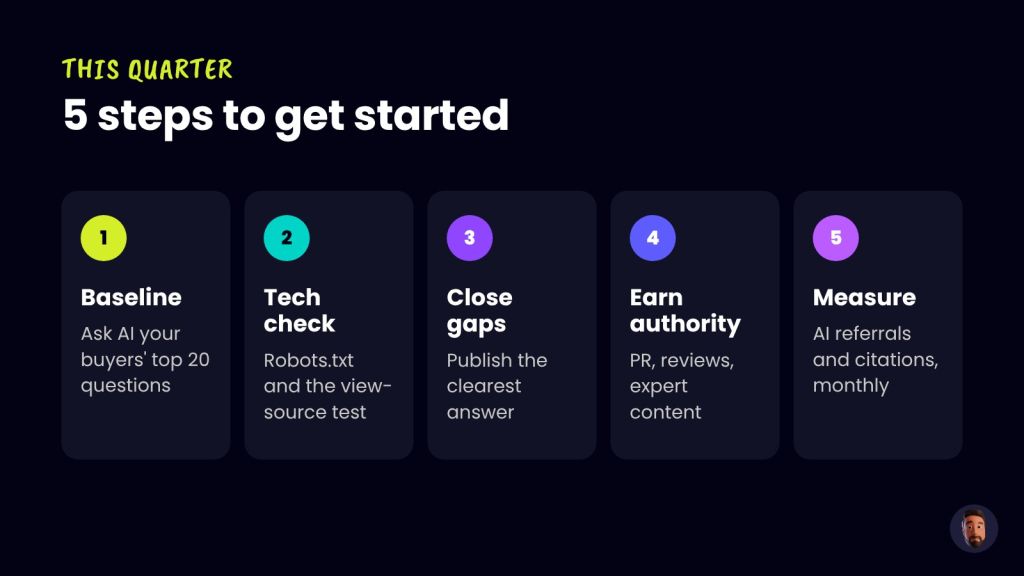
- Baseline. List the 20 questions your buyers ask before they buy. Run them in ChatGPT, Gemini, Google AI Mode and Copilot. Write down who gets mentioned and cited.
- Technical check. Review your robots.txt, run the view-source test on your 10 most important pages, check speed and structured data.
- Close the answer gaps. For every question where a competitor or Reddit wins, publish the clearest answer, with your data and your expert’s name on it.
- Earn authority. PR, reviews, partner pages, expert posts and talks.
- Measure monthly. AI referrals in GA4, Bing’s AI Performance report and your prompt list. Keep what works, kill what doesn’t.
SEO isn't dead. Lazy SEO is.
Search changes its interface every few years, and every few years the same three things keep winning: a site machines can read, content that answers real questions, and a reputation others vouch for. AI didn’t change that. It made the gap between brands that do this well and brands that don’t a lot more visible. Literally: one is in the answer, the other isn’t.
There’s no finish line here. The teams that win are the ones that keep testing.
Quick answers
What’s the difference between SEO and GEO?
SEO (search engine optimisation) helps your pages rank in search results. GEO (generative engine optimisation) helps your brand get mentioned and cited in AI-generated answers, like Google’s AI Overviews, ChatGPT, Gemini, Copilot or Perplexity. They share the same foundation: technical access, helpful content and authority. What changes is the scoreboard.
Do I need an llms.txt file for AI search?
Not for Google, which says it doesn’t need one. It’s harmless to add, but it won’t fix a site that bots can’t read or that doesn’t answer the right questions.
Should I block AI crawlers?
Only if you’ve decided you don’t want to show up in AI answers. Blocking bots that train AI models and blocking bots that power AI search are two different choices, so check which bots you’re blocking.
How do I know if ChatGPT mentions my brand?
Track a fixed list of buyer questions every month, manually or with a prompt-tracking tool, and watch AI referral traffic in GA4. Bing Webmaster Tools also shows how often Copilot cites your pages.
Support
If you liked the article sharing it with your peers is really appreciated. Thank You!